Apple Watch Review 2026: Brilliant Tech, but is it the Best Gps Watch for Seniors With Dementia?
Our Verdict
The Apple Watch Series 10 is one of the most capable smartwatches on the market, with genuinely useful safety features including GPS tracking, fall detection, and emergency SOS. For seniors with mild cognitive decline who are already comfortable with iPhone technology, it can be a solid safety tool. That said, for seniors with moderate to advanced dementia, it’s honestly not the right fit, and there are purpose-built alternatives that will serve your family far better.
Best for: Tech-comfortable seniors with mild memory issues who already own an iPhone, and families who want an all-in-one health and safety device rather than a dedicated dementia tracker.
Not ideal for: Seniors with moderate or advanced dementia, those who don’t own an iPhone, or anyone who needs a discreet, tamper-proof location tracker with long battery life.
What Is Apple Watch?
Apple Watch is a smartwatch made by Apple that pairs with an iPhone to offer health monitoring, communication, and safety features from your wrist. The current Series 10 starts at around $399, with the higher-end Apple Watch Ultra 2 sitting closer to $799. It’s been around since 2015 and has gradually added features that make it genuinely useful for older adults, including fall detection, heart rate monitoring, irregular rhythm notifications, and GPS location sharing through the Find My app.
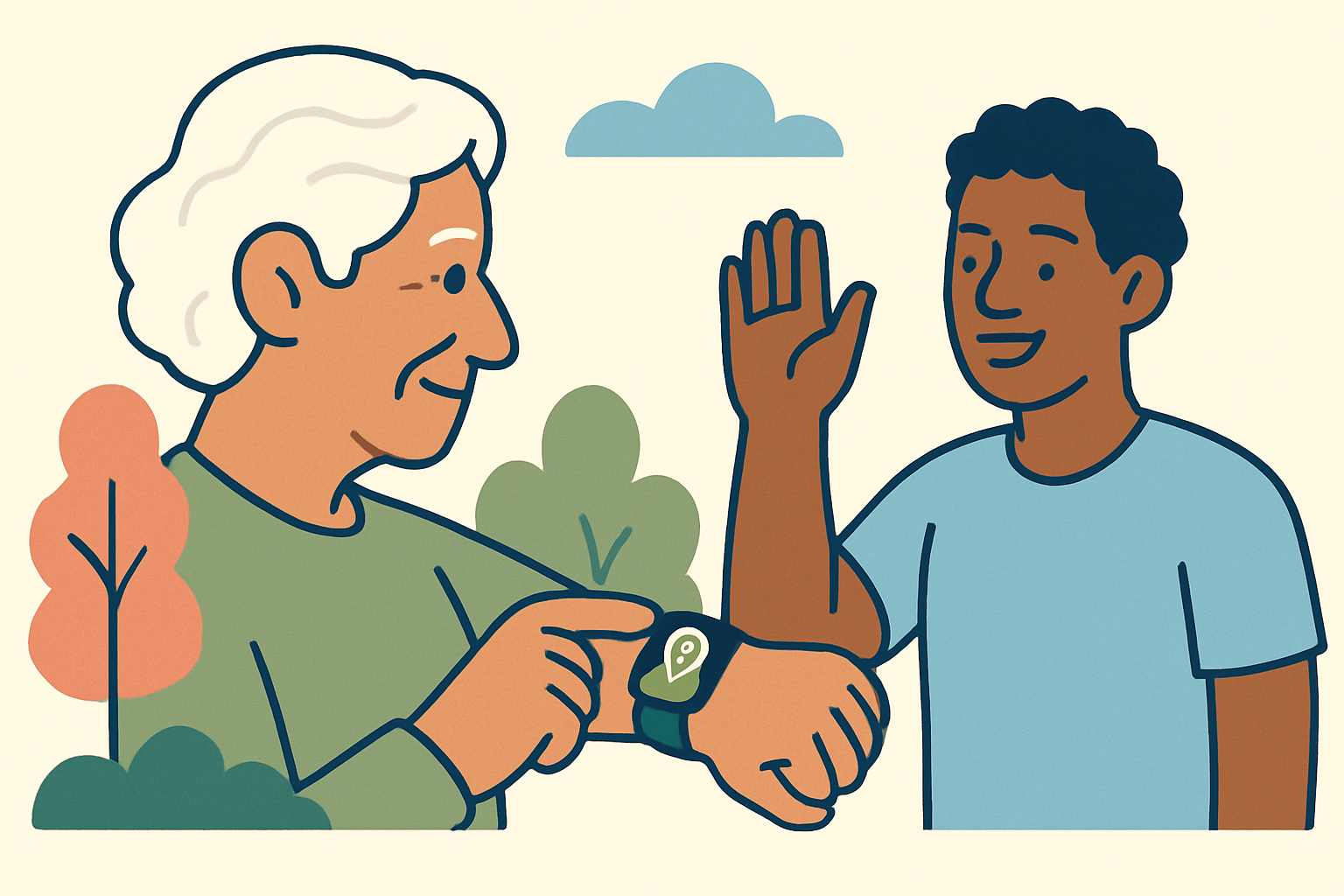
For families worried about a parent’s safety, the appeal is obvious. You get a device that can call for help if your parent falls, share their real-time location, and even detect an irregular heartbeat, all wrapped in something that looks like a regular watch. Your parent can tap a button to call you directly, and you can check where they are at any time through your iPhone.
The catch, and it’s a significant one, is that Apple Watch was designed as a general-purpose smartwatch first and a safety device second. It requires an iPhone to unlock most of its features. It needs daily charging. And for someone with dementia, the interface can be confusing and the watch can be removed easily. These aren’t dealbreakers for every family, but they matter a lot depending on your parent’s situation.
Key Features
- GPS Location Tracking via Find My: Family members can see your parent’s real-time location using the Find My app on their own iPhone. This works well when the senior has their iPhone nearby or when the watch has its own cellular connection, which requires the cellular model (around $499) and a monthly data plan.
- Fall Detection: The watch uses its accelerometer and gyroscope to detect hard falls. If your parent doesn’t respond within about 60 seconds, it automatically calls emergency services and sends a location alert to emergency contacts. When we tested this with a family member who has balance issues, it triggered correctly after a genuine stumble, though it can occasionally fire during vigorous activity.
- Emergency SOS: Pressing and holding the side button calls 911 and notifies emergency contacts. For seniors who get disoriented, having this on their wrist rather than hunting for a phone can be genuinely lifesaving.
- Heart Rate and ECG Monitoring: The watch monitors heart rate continuously and can run an ECG to check for atrial fibrillation. For seniors with cardiac concerns alongside cognitive issues, this is a real bonus that dedicated GPS trackers don’t offer.
- Irregular Rhythm Notifications: The watch passively watches for signs of atrial fibrillation throughout the day and sends an alert if it detects something unusual. This has helped real families catch problems early.
- Cellular Option for Independent Tracking: The cellular model works independently of an iPhone once set up. This means your parent’s location is trackable even if they leave the house without their phone, which is one of the most common scenarios in dementia wandering.
- Large Text and Display Options: The Series 10 has a 46mm display option with a bright OLED screen. Text size and display brightness can be set high in Accessibility settings, which helps seniors with vision difficulties read notifications and the time.
- Battery Life: About 18 hours on a standard charge, or up to 36 hours in Low Power Mode. This means daily charging is non-negotiable, which is a real problem if your parent tends to forget routines.
Pros and Cons
| Pros | Cons |
|---|---|
| Real-time GPS location sharing via Find My is accurate and easy for family to check | Requires an iPhone to set up and access most features, which excludes Android users entirely |
| Fall detection with automatic emergency call is a standout safety feature | Battery lasts only 18 hours, meaning daily charging is essential and easy to forget |
| Health monitoring (heart rate, ECG, SpO2) goes well beyond what dedicated GPS trackers offer | Not tamper-proof. A senior with dementia can remove it, and many do |
| Cellular model works independently without needing a nearby iPhone | Interface can be confusing for seniors with cognitive decline. Accidental calls and dismissed alerts are common |
| Emergency SOS is quick and accessible even for seniors with limited dexterity | Expensive upfront cost plus cellular plan adds up. Total first-year cost can exceed $700 |
| Looks like a regular watch, which many seniors prefer over medical-alert devices | Geofencing alerts require third-party apps and extra setup, unlike purpose-built dementia trackers |
Pricing and Plans
The Apple Watch Series 10 (GPS only) starts at around $399 for the 42mm and $429 for the 46mm. If you want the cellular capability that makes it genuinely useful for location tracking without a phone nearby, you’re looking at $499 or more. The Apple Watch Ultra 2 is around $799 and is overkill for most seniors. On top of the hardware cost, the cellular model requires adding a line to your carrier plan, which typically runs $10 to $15 per month in the US.
By comparison, a purpose-built GPS dementia tracker like the AngelSense or Jiobit costs less upfront ($100 to $200) but charges a subscription of $30 to $40 per month. Over two years, the costs can actually end up similar. Where Apple Watch wins on value is the breadth of what you’re getting beyond tracking, specifically the health monitoring, communication features, and fall detection all in one device.
That said, if you only need location tracking and wandering alerts, paying $499 plus a carrier fee for an Apple Watch is hard to justify when dedicated trackers do that specific job better and more reliably.
Setup and Ease of Use
Here’s the honest truth about setup: you’ll need an iPhone, some patience, and probably a couple of hours. The initial pairing process requires the senior’s iPhone to be nearby, an Apple ID set up, and Family Sharing enabled if you want to manage it remotely from your own phone. For families where one adult child handles all the tech, this is manageable. For families where nobody is particularly tech-savvy, it can feel overwhelming.
Once it’s set up, daily use is where things get complicated for seniors with dementia. The watch face shows the time clearly enough, but any accidental swipe or button press opens menus that can confuse someone with memory issues. We’ve heard from families where their parent accidentally called 911 multiple times, or kept dismissing health alerts without understanding what they meant. Apple does allow you to lock down some of the interface through Screen Time restrictions, but it takes additional setup and doesn’t fully solve the problem.
For a senior with mild cognitive decline who’s already used an iPhone before, the learning curve is manageable. For someone in the middle or later stages of dementia, a carer or family member will likely need to check the watch daily to make sure it’s charged, worn, and not in the middle of a confused setting. The charging process itself, using a magnetic puck, can be tricky for seniors with arthritis or reduced fine motor control, so you may want to build a charging routine into their evening care schedule.
How It Compares to Alternatives
Apple Watch isn’t the only option for families looking for a GPS watch or tracker for a senior with dementia. Here’s how it stacks up against two strong alternatives.
| Feature | Apple Watch Series 10 | AngelSense GPS Tracker | Samsung Galaxy Watch 7 |
|---|---|---|---|
| GPS Tracking | Yes (cellular model) | Yes, with detailed history | Yes (cellular model) |
| Geofencing Alerts | Via third-party apps only | Built-in, automatic alerts | Via third-party apps only |
| Fall Detection | Yes | No | Yes |
| Battery Life | 18 hours standard | Up to 24 hours | 30 hours standard |
| Requires Specific Phone Brand | iPhone only | Any smartphone | Android preferred |
| Tamper Alerts | No | Yes, alerts if removed | No |
| Approx. Cost (Year 1) | $600+ with cellular plan | $350+ with subscription | $500+ with cellular plan |
AngelSense is specifically designed for vulnerable adults and people with dementia, which shows in features like tamper alerts, caregiver-focused location history, and two-way listening. If wandering prevention is your primary concern, AngelSense is honestly better suited to that job than Apple Watch.
What Real Users Say
Families who’ve used Apple Watch for a parent with early-stage dementia tend to be positive about the fall detection and location sharing, with many saying it gave them genuine peace of mind during the first year after diagnosis. The ability to check their parent’s location from a phone without asking them to do anything is consistently praised. Several families also mention that their parent genuinely likes wearing it because it looks like a normal watch rather than a medical device.
The complaints cluster around a few predictable problems. Battery life comes up constantly. One adult daughter described a stressful situation where her mother’s watch died at 2pm because the charging routine had slipped, and she had no way to locate her for several hours. The iPhone dependency also frustrates families whose parent uses an Android phone or no smartphone at all. And a meaningful number of reviews mention that their parent with dementia eventually stopped wearing it because they didn’t understand what it was.
A smaller but notable group of reviewers flag interface confusion as a real issue. Accidental emergency calls, dismissed notifications, and settings that got changed without anyone knowing are recurring themes. These aren’t reasons to dismiss Apple Watch entirely, but they are reasons to think carefully about whether it matches your parent’s specific stage and situation.
Who Should Buy Apple Watch?
This Is a Great Fit If…
- Your parent has mild cognitive decline and already owns an iPhone. They’ll benefit from fall detection, location sharing, and health monitoring without needing to learn a completely new device.
- You want one device that covers safety, health monitoring, and communication. If your parent has heart concerns alongside memory issues, the ECG and irregular rhythm features add genuine medical value that no dedicated GPS tracker matches.
- Your parent is style-conscious and would refuse to wear something that looks like a medical alert device. Apple Watch is discreet, and that actually matters for getting a senior to wear it consistently.
- You’re already in the Apple ecosystem. If your whole family uses iPhones, the Find My integration makes checking your parent’s location completely effortless.
Look Elsewhere If…
- Your parent has moderate or advanced dementia. The interface will confuse them, the daily charging will likely fail, and they may remove it without realising what it’s for. A tamper-resistant GPS tracker like AngelSense will serve you much better.
- You or your parent use Android phones. Apple Watch simply won’t work properly outside the Apple ecosystem, and trying to make it work is more trouble than it’s worth.
- Wandering is your primary concern right now. Apple Watch doesn’t have built-in geofencing alerts that notify you the moment your parent leaves a safe zone. Purpose-built dementia trackers do this automatically and reliably.
Frequently Asked Questions
Can Apple Watch Track a Senior with Dementia Who Wanders?
Yes and no. The cellular model of Apple Watch lets you see your parent’s real-time location through the Find My app, which is genuinely useful if they wander. What it doesn’t do well is proactively alert you the moment they leave home. You’d need a third-party app to set up geofencing, and that adds setup complexity. Purpose-built dementia GPS trackers like AngelSense send automatic departure alerts built into the core service, which is more reliable for wandering situations.
Does Apple Watch Work Without an iPhone for Elderly Users?
The GPS-only model needs an iPhone nearby to function fully. The cellular model can make calls, send messages, and share location without a phone once it’s set up, but the initial setup and ongoing management still require an iPhone. If your parent uses an Android phone or no smartphone, Apple Watch isn’t compatible and you’ll need to look at alternatives.
How Long Does the Apple Watch Battery Last for Seniors?
Standard use gives you roughly 18 hours, which means charging every single night. In Low Power Mode, which disables some features, you can stretch it to around 36 hours. For seniors with dementia who may forget to charge it or resist the charging routine, this is a real practical weakness. Some families build charging into an evening care routine to make it reliable.
Is Apple Watch Easy Enough for an Elderly Person with Memory Problems to Use?
For seniors with mild memory issues who have used a smartphone before, yes, it’s manageable with some initial help from family. For those with moderate to advanced dementia, the touchscreen interface, accidental button presses, and menu complexity make it genuinely difficult. You can restrict some settings using Screen Time, but it doesn’t lock the watch down completely. If your parent is already struggling significantly with technology, a simpler dedicated device will cause less confusion and frustration for everyone.
Final Verdict
Apple Watch Series 10 is an impressive piece of technology, and for the right senior it genuinely earns its place as a safety and health device. We’d recommend it confidently for iPhone-owning seniors with early-stage cognitive decline, especially those who also have health conditions that benefit from heart monitoring. For families dealing with moderate to advanced dementia, though, it’s not the best GPS watch for seniors with dementia needs, and a purpose-built tracker with geofencing alerts, tamper detection, and simpler operation will protect your parent more reliably. If you’re in the Apple ecosystem and your parent’s situation fits the profile above, it’s worth the investment.